
A DAW that works with what you already have.
Fontelle is a free, open-source digital audio workstation for Windows, macOS and Linux. Load an .sf2 and every loop point, envelope, filter and mapping in it is yours to edit. Bring the CLAP, LV2 and VST® 3 plugins already on your machine. Around that sits a full studio in one small native binary: arrangement and piano roll, a mixer with built-in effects, a synthesiser with 338 presets, a drum machine, an autotune and audio recording. No account, no cloud, no fees.
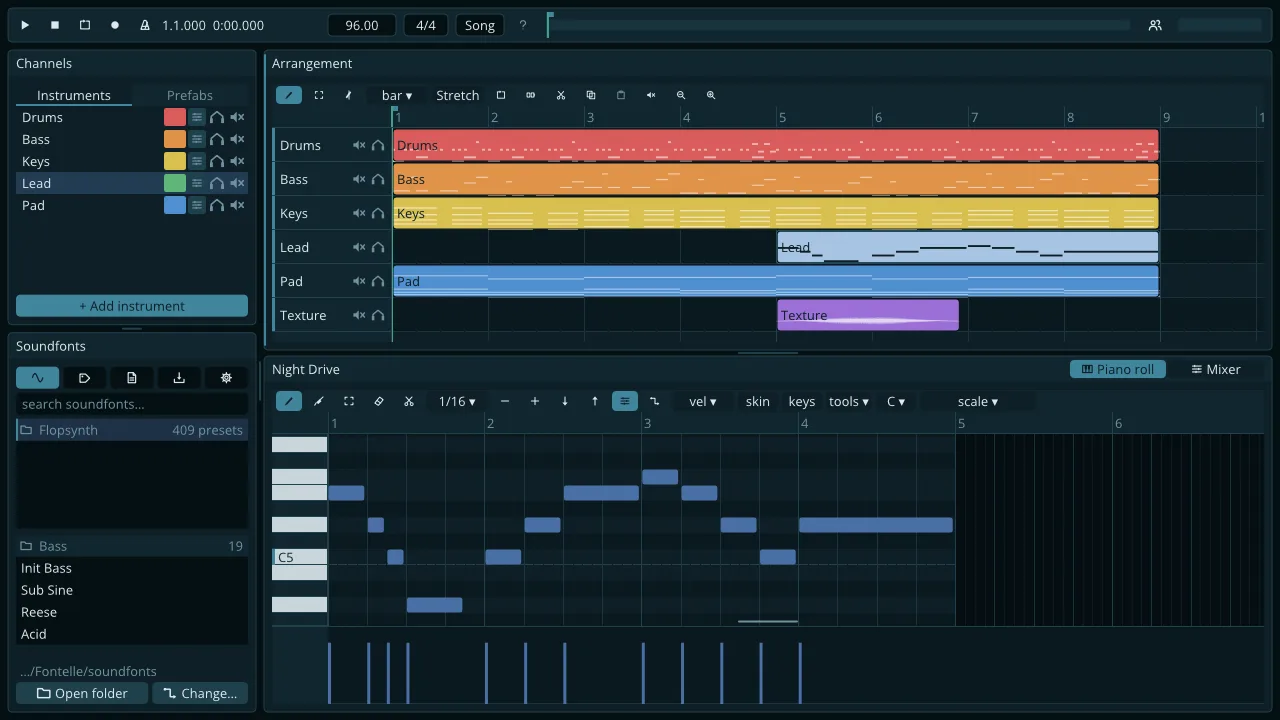
Compatibility first, so more people can make music.
Most studio software is closed, decades deep, and open only on its own terms. Fontelle takes the other road: small, open all the way down, and built to load what you already own rather than sell you a replacement for it.
Works with what you have
Your SoundFonts, with every parameter yours to edit. Your CLAP, LV2 and VST 3 plugins, and VST 2 by a free extension. MIDI files, FL Studio scores, WAV in and out.
Runs where you are
Windows, macOS and Linux, from one codebase and one release. One small native binary, no installer to trust, no account to make, nothing sent anywhere.
Open all the way down
MIT or Apache-2.0, every line on GitHub. If something is missing, it can be read, filed, fixed or forked. The tooling to make music should not be the thing standing in the way of it.
Get Fontelle 0.6.0.
One archive per platform, straight from the GitHub release. Every archive is listed with its SHA-256 in the release's SHA256SUMS, and the app's own updater downloads these same files.
Windows x86_64 · zip
fontelle-0.6.0-x86_64-pc-windows-msvc.zip
Unzip and run fontelle.exe. The binary is unsigned, so if SmartScreen appears choose More info, then Run anyway.
macOS Apple Silicon · tar.gz
fontelle-0.6.0-aarch64-apple-darwin.tar.gz
Unpack and run fontelle. The binary is unsigned, so right-click it and choose Open the first time.
macOS Intel · tar.gz
fontelle-0.6.0-x86_64-apple-darwin.tar.gz
Same archive layout and the same first-run step as Apple Silicon.
Linux x86_64 · tarball with an installer
fontelle-0.6.0-x86_64-unknown-linux-gnu.tar.gz
The tarball holds the fontelle binary, both licences, a README, a .desktop entry, the icon and install.sh. The installer puts it in ~/.local/bin with a menu entry, nothing outside your home folder, no root. ./install.sh --uninstall takes it away again.
- Unpack the tarball and step into the folder.
- Run the installer. It copies the binary and the menu entry, and says so if a library is missing.
- Start
fontellefrom your application menu.
tar xzf fontelle-0.6.0-x86_64-unknown-linux-gnu.tar.gz
cd fontelle-0.6.0-x86_64-unknown-linux-gnu
./install.sh
Needs lilv from your distribution for LV2 hosting: Debian and Ubuntu sudo apt install liblilv-0-0; Fedora and Arch, the package is lilv. It also links ALSA and D-Bus, which a desktop already has. The installer checks and tells you what to install if anything is missing.
Where it is most used. All three builds come off the same CI with the full test suite run on each. Linux is where Fontelle gets the most use today, so Windows and macOS are less exercised: on those two, plugin editors are not shown and LV2 is not hosted; CLAP and VST 3 plugins still load and play, edited through Fontelle's own parameter panel, only their own windows do not open.
The binaries are unsigned. Expect the first-run warning on Windows (SmartScreen) and macOS (right-click, Open). Check what you downloaded against the release's SHA256SUMS if you want to be sure.
A SoundFont is a starting point.
Every existing SoundFont player treats the file's parameters as authoritative: the loop points, the envelopes, the filter, the mapping are whatever the file says, and that is that.
Fontelle inverts that. The .sf2 seeds the defaults, and the instrument editor exposes every one of them as a value you own: loop points, envelopes, filters, LFOs, the modulation matrix, key and velocity mapping, tuning. Change them, save them with the project, automate them from the arrangement. An old General MIDI bank becomes raw material.
- Loop points, envelopes, filters, LFOs, the modulation matrix, key and velocity mapping, tuning: all yours to edit
- Every override is a real-time value, and every one is automatable
- Saved with the project bundle, which reopens with its audio

A full studio in one small binary.
Rust from top to bottom, with a custom GPU-drawn interface (wgpu and vello) in dark and light themes. The Linux download is 15.0 MB.
Arrangement
- Lanes with MIDI, audio and automation clips
- Looping, clip stretch and cut, fades, a blade tool
- Prefabs: one set of notes placed in many places
- Tempo map with changes, time signature, a metronome
- Transport with loop ranges and song or clip modes
Piano roll
- Draw, paint, select and delete tools
- Snap from a bar down to 1/32, triplets, or off
- Velocity and property lane, ghost notes
- Arpeggiator, legato joining (Ctrl+L), slides and pitch bends
- Per-note channel for multi-instrument clips
Sound
- SoundFont (.sf2) sampler with real-time parameter override
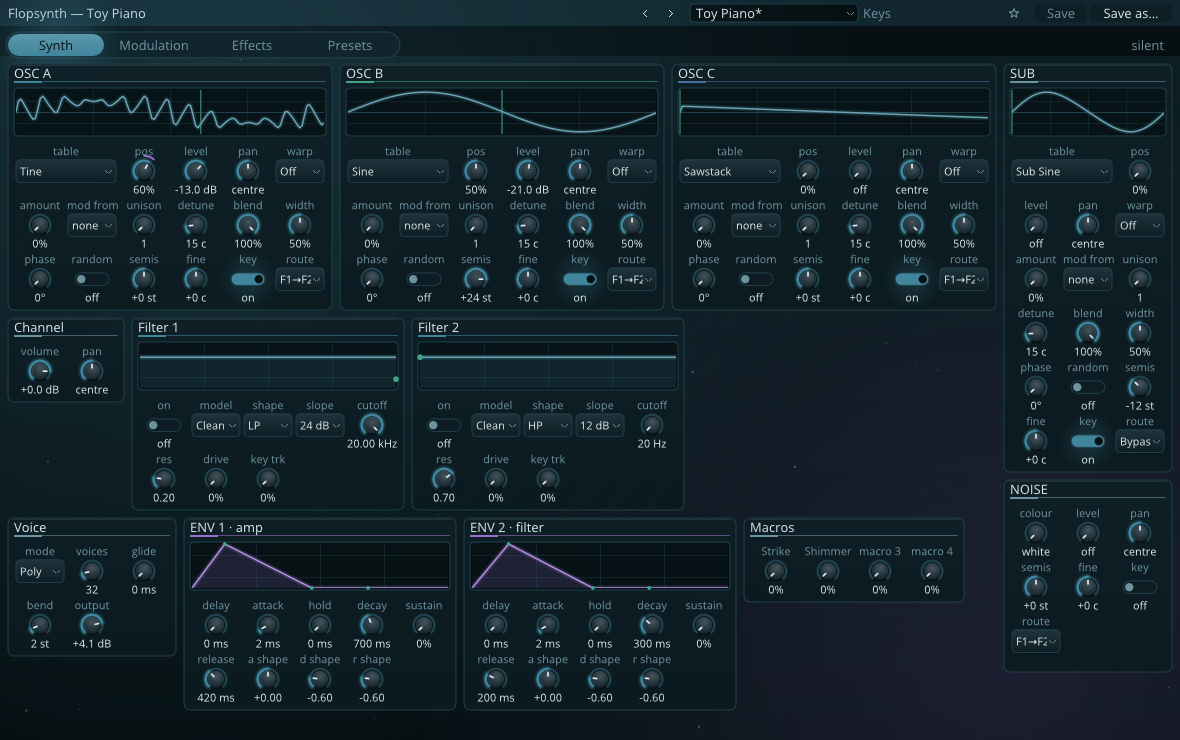
- Flopsynth: oscillators with unison, sync and FM, filters with drive, envelopes, LFOs, a mod matrix, macros, its own effect chain, and 338 factory presets on shelves (Bass, Keys, Pads, Leads, Sync & FM, World, Cinematic, Lo-Fi & Tape, Modular and more)
- Drum machine with physically modelled kits (resonator bodies rather than samples) on their own bus
- Sampler channels from any audio file you drag in
Mixing and effects
- Tracks, sends, routing, a master bus with a brickwall limiter
- Per-track insert chains with wet/dry and delay compensation
- Track presets, including sixteen shipped vocal chains
- Built-in families: Utility, EQ with a spectrum, Filter, Compressor with external sidechain, Gate, Distortion, Bitcrush, Soften, Chorus, Delay, Reverb
- Tune: an autotune with a keyboard-driven scale, presets and a colour control
- Every knob is automatable
Plugins
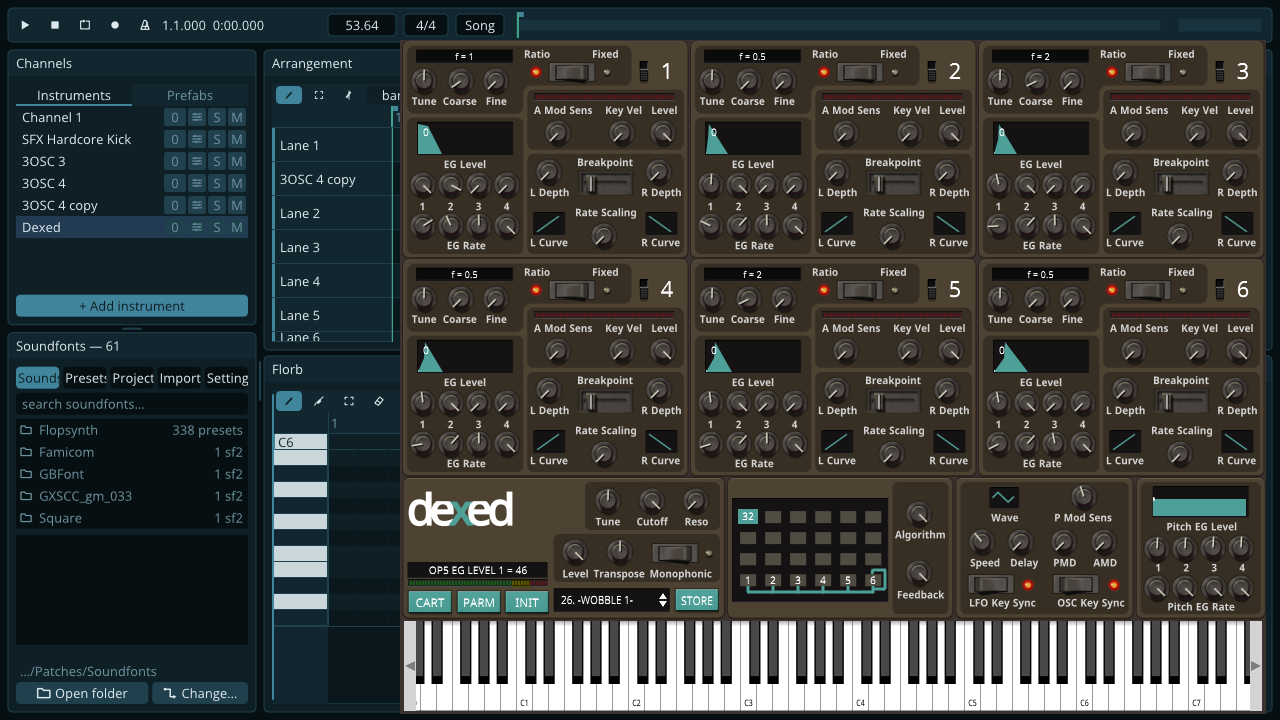
- Hosts CLAP, LV2 and VST 3 instruments and effects in the shipped binary
- Their own editor windows on Linux, their parameters on every platform, state saved in the project
- Favourites in every picker
- Scans the standard locations plus folders you add
- Plugins in the VST 2.4 format through a free, open-source extension, installed from the app's Extensions page: a separate, opt-in download for Linux, Windows and macOS (
fontelle-vst2)
Audio, MIDI and projects
- Audio import, playback, recording with monitoring, a clip editor, offline render to WAV
- Live MIDI input with hot-plug, per-device velocity curves, transpose and channel filter
- MIDI recording, MIDI file import,
.fsc(FL Studio score) import - Full undo and redo, autosave and backups
- Project bundles (
Name.fontellefolders) that reopen with their audio
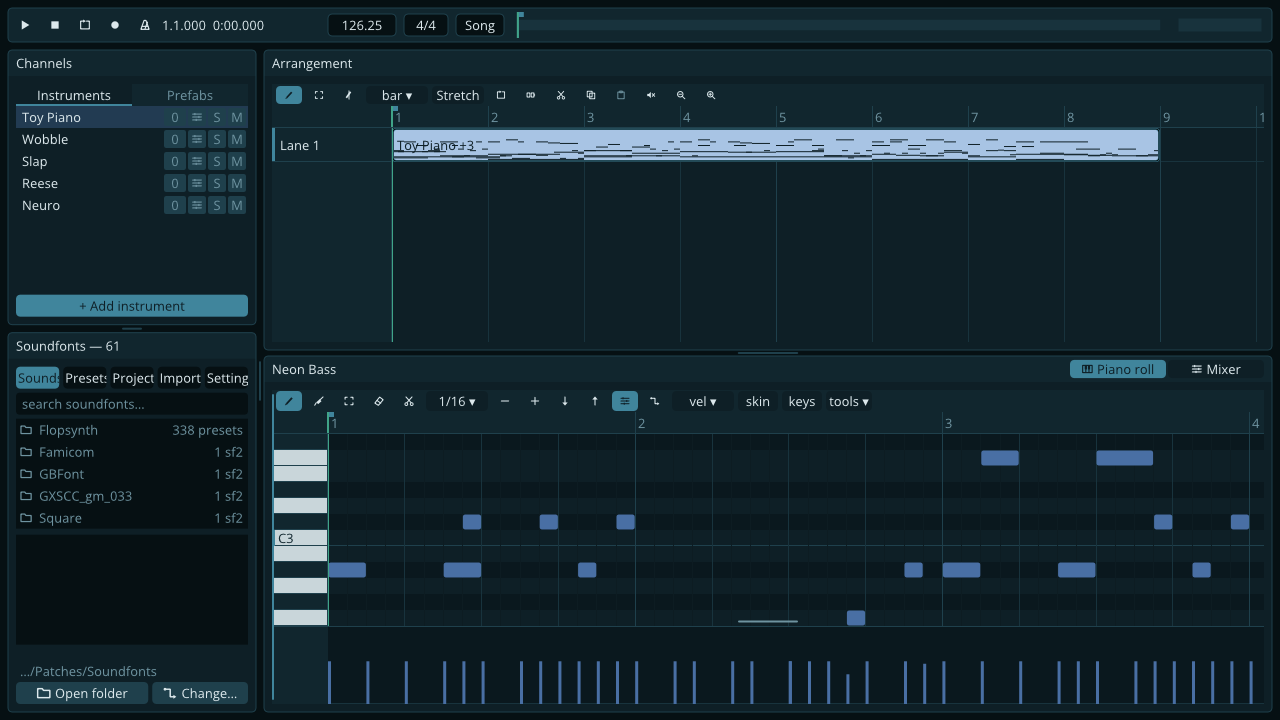
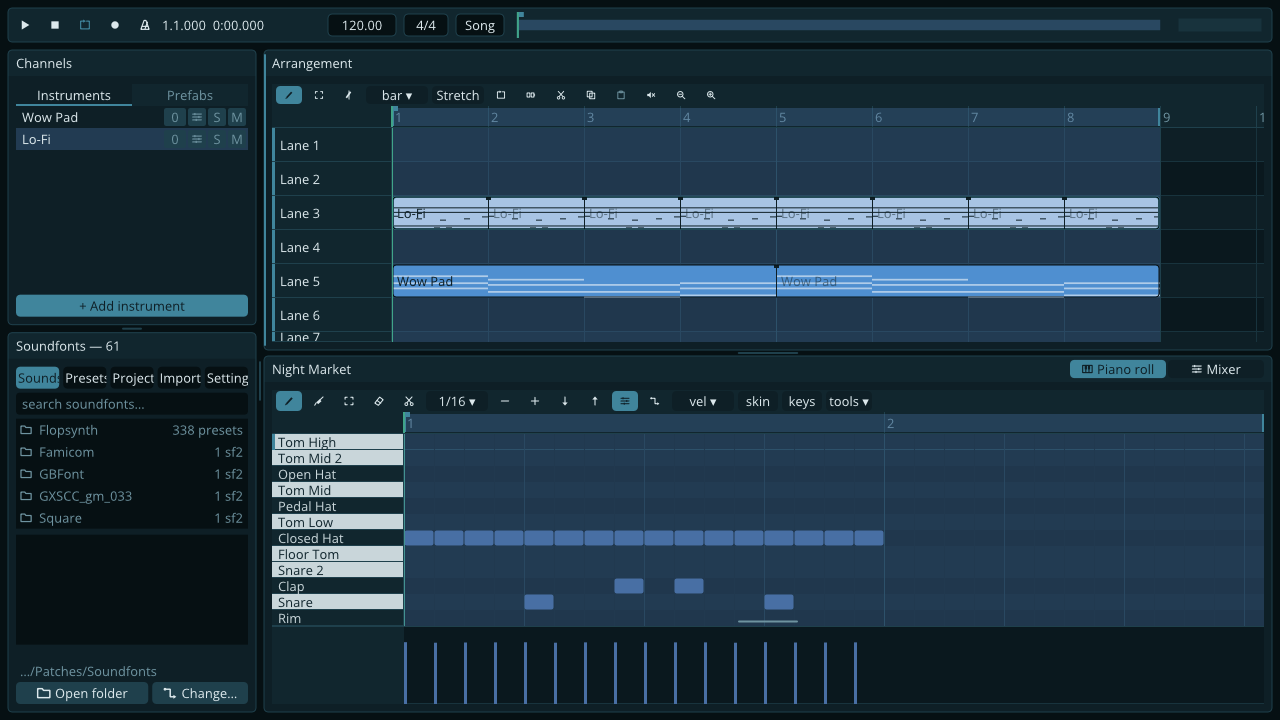
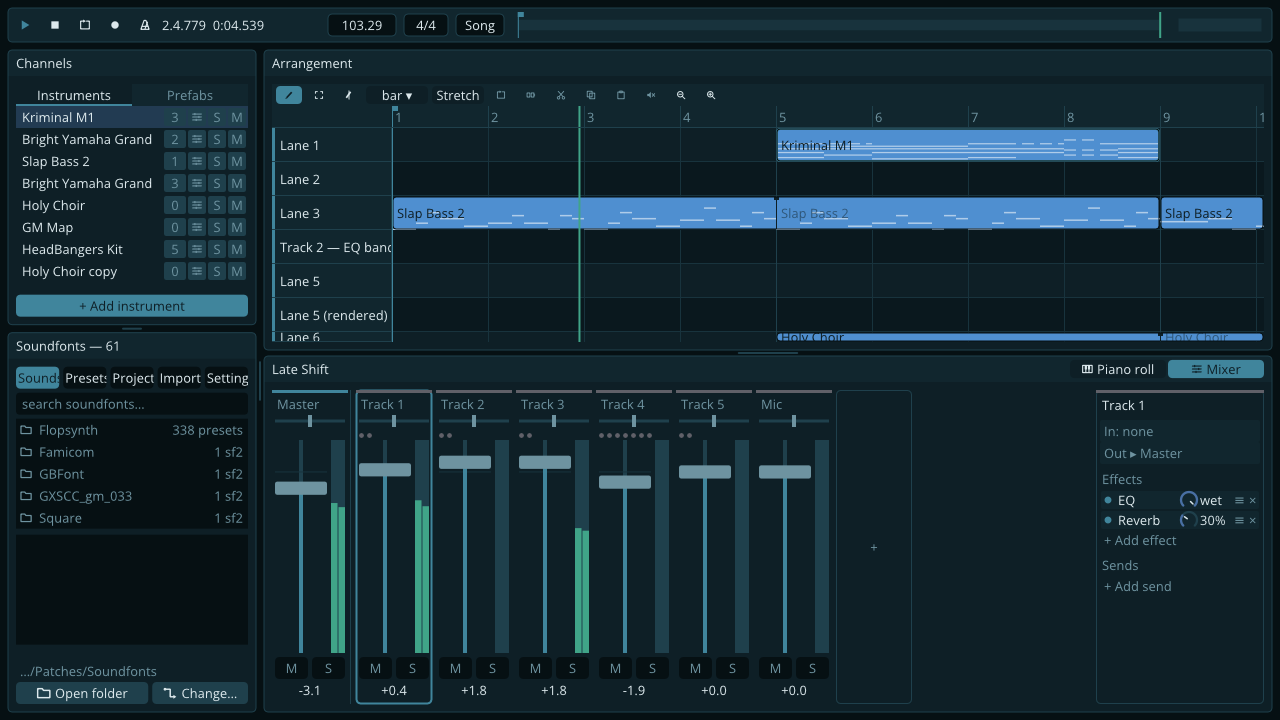
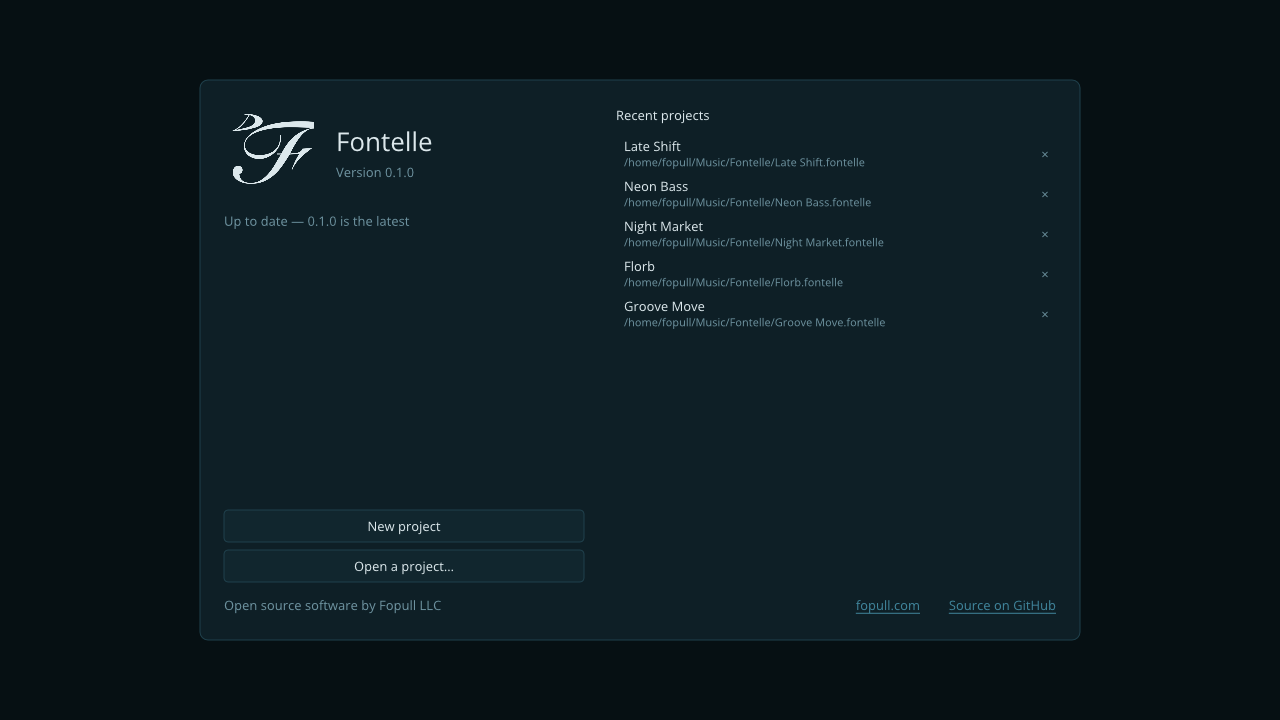
What it looks like right now.
Taken from the 0.6.0 binary. This is the current chrome, not a mock-up.

It keeps itself up to date.
Fontelle opens on a start menu: your recent projects, New project, Open a project, and whether there is a newer version. When there is, an Install update button downloads the release archive, verifies it against the published SHA256SUMS, and swaps the binary in place. If it cannot write there, it opens the release page so you can install by hand.
That update check is the only network request the program ever makes. There is no telemetry and no account, and the check itself can be turned off on the Settings tab.
Free, open source, and early.
Fontelle is dual-licensed MIT OR Apache-2.0, by Fopull LLC. No royalties, no fees, no account, no telemetry. It is version 0.6.0: a working studio with a long design list still ahead of it. Read the source, file an issue, send a pull request. A star on the repository helps it reach people.
VST is a registered trademark of Steinberg Media Technologies GmbH.
Questions, answered.
What is Fontelle?
Fontelle is a free, open-source digital audio workstation from Fopull LLC for Windows, macOS and Linux, built to work with what you already have. It is a full studio in one small native binary: an arrangement timeline and piano roll, a mixer with built-in effects, a SoundFont sampler, its own synthesiser (Flopsynth), a physically modelled drum machine, an autotune, audio recording, and hosting for the CLAP, LV2 and VST 3 plugins already on your machine. It is early access, and it is a working studio.
What makes it different from other DAWs?
The SoundFont handling. Every other SoundFont player treats the parameters inside an .sf2 file as fixed. Fontelle treats them as defaults: load a SoundFont and every loop point, envelope, filter, LFO, modulation route, key and velocity mapping and tuning in it becomes a value you own, can change, and can automate. The file is a starting point rather than a locked instrument.
Which platforms does it run on?
Windows on x86_64, macOS on both Apple Silicon and Intel, and Linux on x86_64, all from the same release workflow with the whole test suite run on each. Linux is where Fontelle gets the most use today, so the other two are less exercised. On Windows and macOS, plugin editors are not shown and LV2 plugins are not hosted; CLAP and VST 3 plugins still load and play, edited through Fontelle's own parameter panel, only their own windows do not open.
Is it really free? What is the licence?
Yes. Fontelle is free and open source, dual-licensed MIT OR Apache-2.0. No royalties, no fees, no account, and no cloud. The source is on GitHub at github.com/Fopull-LLC/DAW-Fontelle.
Does it host plugins? Which formats?
It hosts CLAP, LV2 and VST 3 instruments and effects in the shipped binary, with plugin state saved in the project, favourites in every picker, and a scan of the standard plugin folders plus any you add. On Linux a plugin opens its own editor window; on Windows and macOS it is edited through Fontelle's own parameter panel. Plugins in the VST 2.4 format load through a free, open-source extension that the app offers to install from its Extensions page. It is a separate, opt-in download on Linux, Windows and macOS, kept out of the core binary on purpose.
How do I get VST 2 plugins working?
Open Extensions inside Fontelle and install the VST 2 extension. It is free, open source (MIT OR Apache-2.0, at github.com/Fopull-LLC/fontelle-vst2), built for Linux, Windows and macOS, and it adds loading of plugins in the VST 2.4 format. On Linux it also loads the plugins yabridge makes of Windows VST 2 plugins.
Is it ready for real work?
It is version 0.6.0 and early access. There is a window you can write a whole piece in, with full undo and redo, autosave and backups, and project bundles that reopen with their audio. There is also a lot still on the design list, so expect rough edges and frequent releases. For anyone who wants a number that is true: the test suite is around 3,900 passing tests on Linux.
Does it send any data anywhere?
No telemetry and no account. The only network request Fontelle ever makes is the optional update check when it starts, against the GitHub releases API, and there is a setting on the Settings tab to turn that off.
How do I install it on Linux?
Download the Linux tarball, unpack it, and run ./install.sh from the unpacked folder. It puts the fontelle binary in ~/.local/bin with a menu entry and an icon, nothing outside your home folder and no root. ./install.sh --uninstall takes it away again. The binary needs lilv from your distribution for LV2 hosting: on Debian and Ubuntu, sudo apt install liblilv-0-0; on Fedora and Arch the package is lilv. The installer tells you if anything is missing.
Why does my system warn me about the download?
The binaries are unsigned for now. On macOS, right-click the binary and choose Open the first time. On Windows, if SmartScreen appears, choose More info and then Run anyway. The published SHA256SUMS file on each release lets you check what you downloaded.
How do updates work?
From the start menu. On launch Fontelle checks the releases API and, when a newer version exists, shows an Install update button. That downloads the release archive, verifies it against the published SHA256SUMS, and swaps the binary in place. If it cannot write there it opens the release page instead so you can install by hand.
Where do I report a bug or ask for something?
On GitHub: open an issue at github.com/Fopull-LLC/DAW-Fontelle. It is an open-source project and contributions are welcome.
Fontelle is one of a few things we build and give away.
Fopull LLC also makes Floptle, an open-source Rust game engine, and Storage Sifter, a disk-usage treemap for Linux, plus Foduel, a browser trading card game on Foverse. If a Rust DAW brought you here, the rest is worth a look.